
CASE STUDY · AI PRODUCT · BUSINESS PLATFORM
Turning a complex valuation engagement into one structured digital workflow.
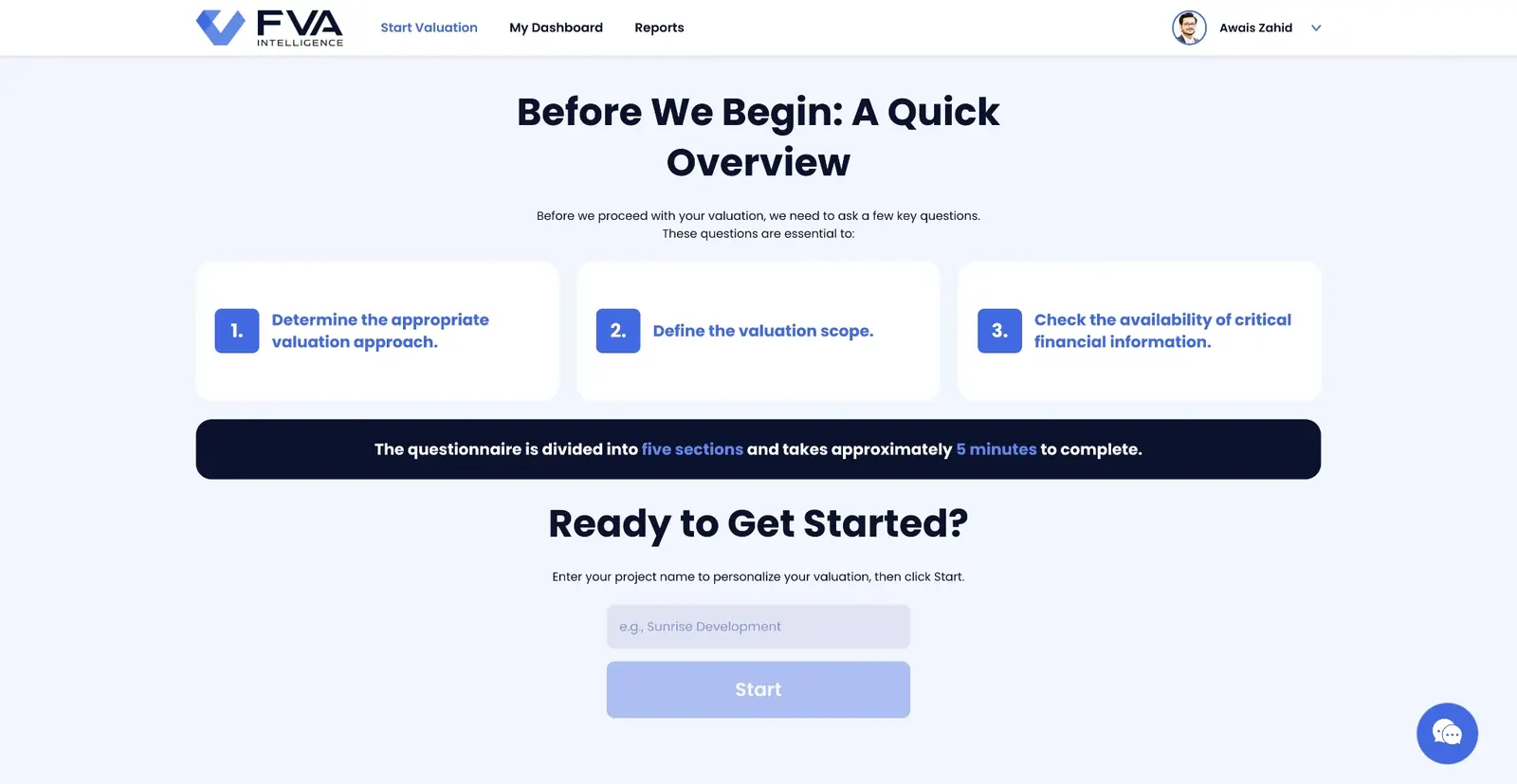
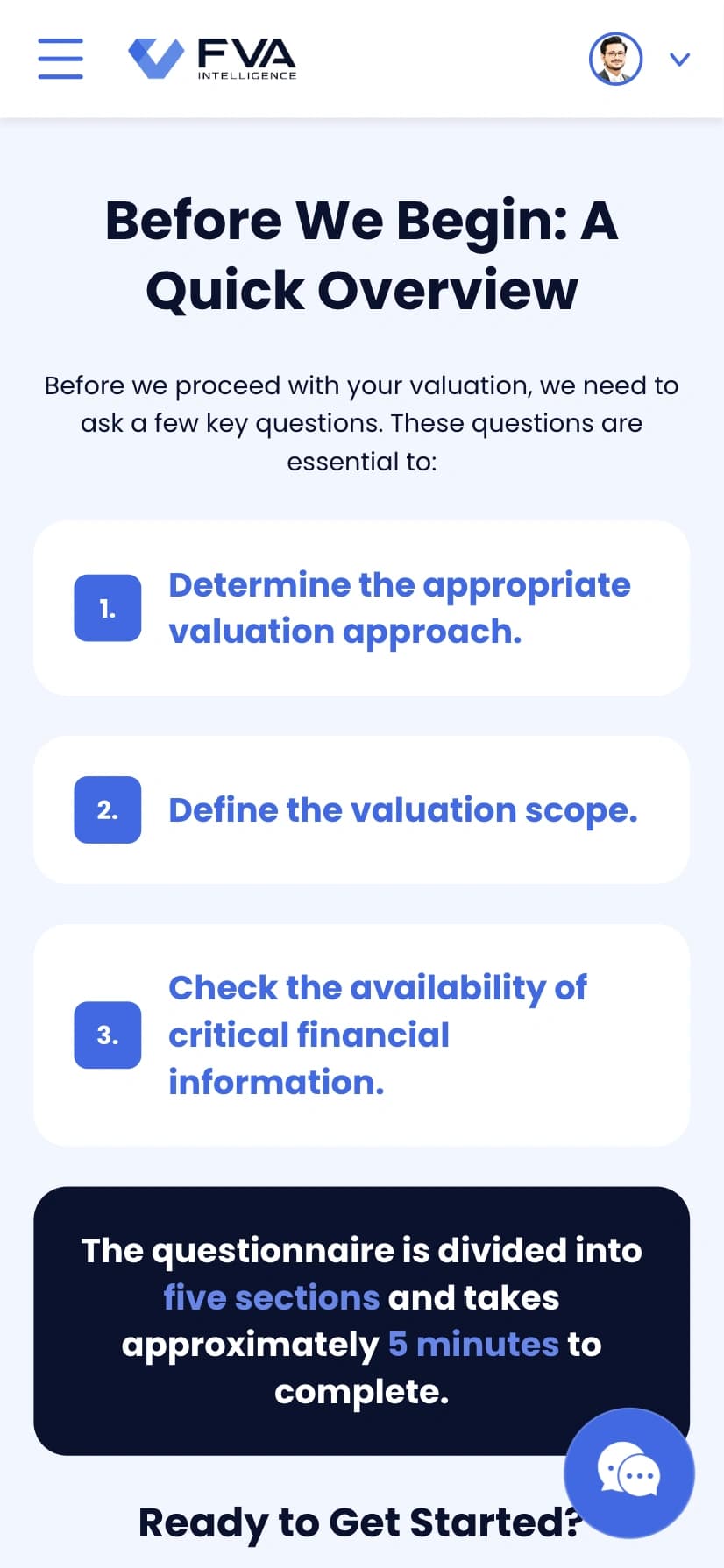
Business valuation involves more than answering a short questionnaire. I built a platform that brings client intake, financial information, document submission, AI-assisted analysis, staged report generation and advisor-facing workflows into one system.
THE CHALLENGE
Make the product better without adding unnecessary complexity.
A professional business valuation pulls information from several places: company details, financial inputs, supporting documents, valuation assumptions, analysis and final reporting. When those pieces live across forms, spreadsheets and email, the engagement becomes difficult to track and repeat consistently.
The product needed to organize that work without hiding the judgement involved in valuation. Automation had to support the professional workflow, not reduce it to a black-box number.
WHAT I BUILT
The work behind the result.
Structured financial intake
Built a multi-step application flow for collecting business and financial information in a form that can be validated, stored and used throughout the valuation process.
Document submission portal
Created a clear place for clients to provide supporting documents so the engagement is not dependent on scattered email attachments.
AI-assisted analysis pipeline
Connected structured inputs and supporting information to a staged analysis workflow that helps produce consistent valuation content and report sections.
Dashboard and reporting
Built the operational side of the product around engagement status, analysis progress and professional report generation for client delivery.
TECHNICAL APPROACH
Keep the architecture focused on the workflow.
- 01
Model the engagement as a sequence of clear stages instead of one oversized form or one AI prompt.
- 02
Keep structured financial data separate from uploaded source documents so each can be validated and used appropriately.
- 03
Use AI inside defined analysis steps where it can accelerate drafting and synthesis while the application keeps control of the workflow and data.
- 04
Design the reporting and dashboard layers as first-class product features because delivery is part of the valuation service, not an afterthought.
Next.jsPostgreSQLAnthropic Claude APIAIReport generation
OUTCOME
What changed after the build.
One engagement workflow
Client intake, documents, financial data, analysis and reporting now live inside the same product instead of being spread across disconnected tools.
More repeatable delivery
A staged pipeline gives each engagement the same operational structure while leaving room for professional review and judgement.
Client-ready reporting
The platform carries the work through to professional report generation rather than stopping after an internal calculation or dashboard result.
KEEP EXPLORING
Related work and thinking.
START A PROJECT
Have a manual business process that has outgrown forms, spreadsheets and email?
Send me the current workflow, the people involved and what the final deliverable looks like. I can help identify which parts belong in a custom application and which should stay deliberately human.
Tell me what you are building